

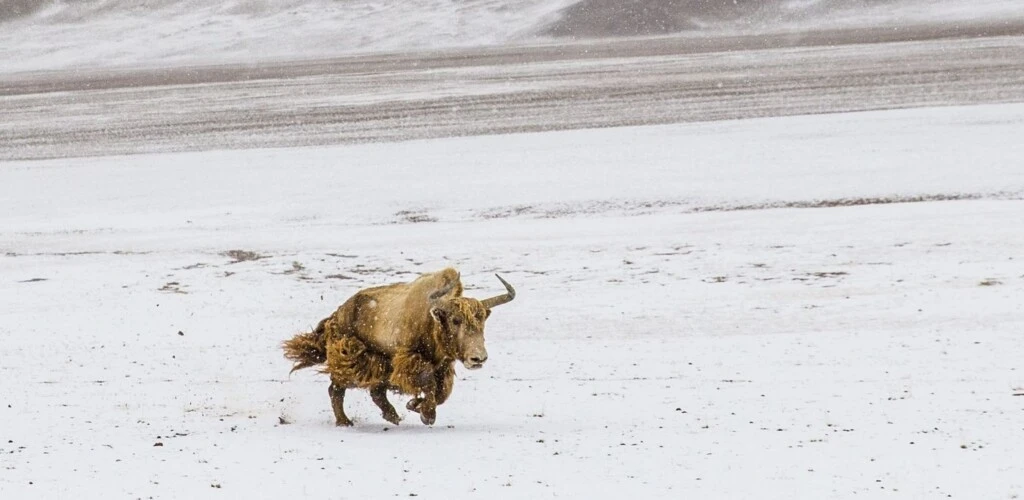
China has reached an important milestone in wildlife conservation by successfully cloning wild yaks for the first time. Scientists hope the breakthrough could help strengthen wild yak populations and eventually support efforts to save one of China’s rarest and most striking animals: the golden wild yak.
According to local legend, when Mount Buye on the Tibetan Plateau married Mount Zhaxiangqian, seven golden wild yaks were given as a dowry. That story is said to explain why these unusual golden animals are found only high in the mountains.
Conservationists see a more urgent explanation. Golden wild yaks have become extremely rare because of hunting, competition, hybridization and habitat pressures. Today, they are considered critically endangered, with some estimates suggesting only around 170 to 300 remain.
Wild yaks are native to the Qinghai-Tibet Plateau, where they evolved over thousands of years to survive freezing temperatures, thin air and harsh mountain conditions. They are the ancestors of domestic yaks, which became essential to people living in the Himalayas by providing wool, milk, oil and dung for fuel.
Golden wild yaks are a genetically distinct form of wild yak found in the highest parts of the plateau. Their coats are a burnished gold color, and genomic research suggests they carry special traits that help them survive in high-altitude environments.
Despite strong legal protections, their small population remains vulnerable. Hundreds of local herders and farmers help protect them by keeping domestic yaks away from their habitat in Changtang National Park and by patrolling for poachers.
To support conservation efforts, researchers from Zhejiang University and the Institute of Plateau Biology of Xizang began building a detailed genetic record of wild yaks. In 2023, they sequenced the genomes of nearly 9,000 wild yaks to create a broad genetic inventory before launching a cloning program.
The team later achieved the first successful wild yak cloning in history. More recently, they advanced the work by cloning 10 wild yaks at once. The cloned embryos were carried and delivered naturally by female yaks, showing that the method can work.
The goal is to establish a new wild herd using genes from across the wild yak population. Once that foundation is stronger, scientists hope to focus more directly on the golden wild yak.
The golden wild yak’s genome has already been sequenced, and researchers have identified traits connected to its golden coloring, high-altitude tolerance, immune response and reproduction. Scientists have described the animal as an evolutionarily significant unit with major conservation value.
Experts warn that protecting the golden wild yak will require preventing further inbreeding and reducing the risk of hybridization with common wild yaks or domestic yaks.
Cloning is not a complete solution on its own, but it could become one tool in a wider conservation strategy. Combined with habitat protection, anti-poaching efforts and careful genetic management, it may help preserve this rare mountain animal.
With science, patience and continued protection, the golden wild yak may remain part of the Tibetan Plateau’s wild landscape — not only as a legend, but as a living species.