

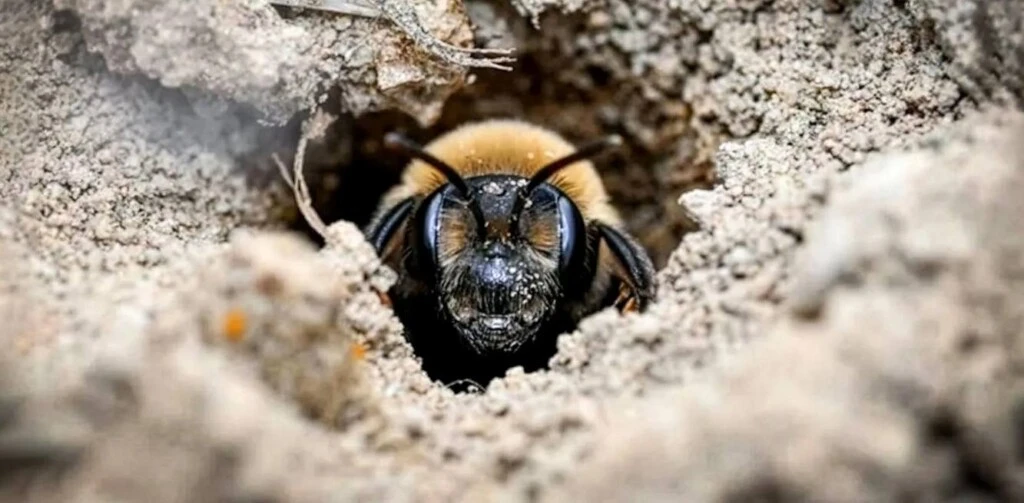
A huge colony of ground-nesting bees discovered beneath a New York cemetery may be one of the largest bee aggregations ever documented.
Scientists estimate that around 5.5 million bees are living under East Lawn Cemetery in Ithaca, New York. Even more surprisingly, research suggests the bees may have been nesting there for more than 100 years, quietly thriving in the cemetery’s sandy, undisturbed soil.
The discovery began in spring 2022, when Rachel Fordyce was walking through the cemetery on her way to work at a Cornell University entomology lab. She often parked nearby to save money and crossed the cemetery on foot. During one of those walks, she noticed bees everywhere.
Curious, Fordyce collected a few in a jar and brought them to her supervisor, Bryan Danforth, a professor of entomology at Cornell University. The insects were identified as Andrena regularis, also known as the regular mining bee.
These bees are solitary wild bees that nest underground. Unlike honeybees, they do not live together in hives, but many individuals can nest close to one another in large groups. They are also important pollinators for wild plants and crops.
That simple observation led to an extraordinary finding: a massive nesting site spread across about 1.5 acres. Researchers estimated the population at about 5.5 million bees, though the true number may range from roughly 3 million to 8 million.
To study the colony, scientists used small mesh emergence traps. These tent-like traps were placed over patches of ground so researchers could collect insects as they came out of their underground nests.
Between March 30 and May 16, 2023, the team placed 10 traps around the cemetery. They collected 3,251 insects from 16 species, including bees, beetles and flies. But Andrena regularis made up the overwhelming majority.
Using the number of bees caught in the traps, researchers calculated the average bee density across the cemetery and estimated the total population.
Historical records also showed that A. regularis has been present at East Lawn Cemetery since at least the early 1900s. The cemetery itself dates back to 1878, meaning the land has likely offered stable habitat for generations.
The discovery highlights how valuable cemeteries can be for wildlife. Because older cemeteries are often quiet, lightly disturbed and free from heavy pesticide use, they can become safe places for plants, insects, birds and mammals.
East Lawn Cemetery appears to be especially good habitat because of its sandy soil, which these bees prefer. Nearby Cornell Orchards may also help support the colony by providing plenty of spring flowers, including apple blossoms.
Researchers say the colony is important not only because of its size, but also because solitary ground-nesting bees are valuable crop pollinators. They can help pollinate apples and other plants, making them important to both ecosystems and agriculture.
The cemetery’s superintendent, Keven Morse, said he has seen many animals on the property over the years, including deer, geese, hawks, foxes, coyotes and countless bees. In some areas, the bees are so active that he has felt bad mowing nearby.
Scientists say sites like this need protection. If the nesting area were paved over or heavily disturbed, millions of important pollinators could be lost very quickly.
The hidden bee colony beneath East Lawn Cemetery is a reminder that remarkable wildlife communities can exist in unexpected places — sometimes right under our feet.