

When dinosaurs still ruled the planet, early mammals were small, cautious creatures that often sheltered underground. Those burrows may have created an important opportunity for another group of animals: early snakes. Their narrow bodies could slip into tight spaces where mammals lived, giving them access to prey that other predators could not easily reach.
That idea is one possible explanation for how snakes began, according to evolutionary biologist Marc Tollis of Northern Arizona University. But scientists still do not know the full story. The snake fossil record is incomplete, and many major questions remain unresolved, including where snakes first evolved and which reptiles are their closest relatives.
What researchers do know is that snakes became incredibly successful. Around 125 million years ago, they began diversifying rapidly. Their flexible bodies helped them spread across land, into water, underground and even into trees. Today, snakes live on nearly every continent and in a huge variety of environments.
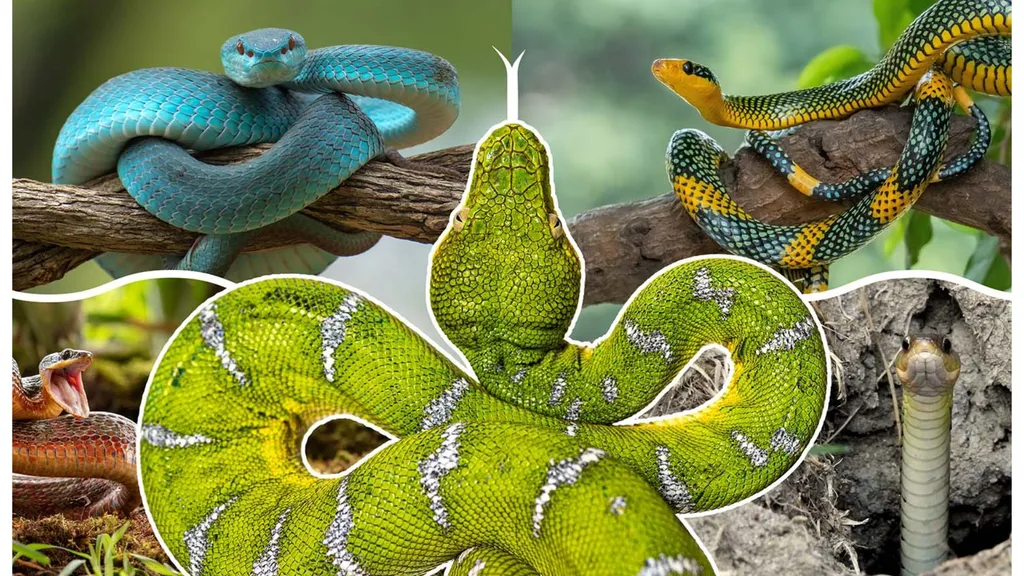
Modern snakes show an astonishing range of forms and abilities. Some are tiny threadsnakes only a few inches long, while some pythons can grow longer than 20 feet. Some snakes chase prey, while others wait quietly to ambush it. Some squeeze their prey, others use venom, and some can even reproduce without males.
This diversity is especially impressive because snakes seem limited in obvious ways. They have no legs, cannot chew and must swallow prey whole. Yet despite these challenges, they have become one of the most successful groups of reptiles.
Scientists estimate that the ancestors of modern snakes appeared around 160 million years ago. However, the earliest known snake fossils come from different environments, making it difficult to know whether snakes first evolved on land, in water or underground.
For a long time, some researchers believed snakes began as burrowing animals. This idea came partly from blind snakes, which sit near the base of the living snake family tree and have tiny eyes. But blind snakes are highly specialized for life in anthills and termite mounds, so they may not represent what the earliest snakes were actually like.
Another theory suggested that snakes had a marine origin. Fossils of ancient aquatic snakes from the Middle East, along with possible links to extinct sea reptiles called mosasaurs, once made this idea seem plausible. But older terrestrial snake fossils have since weakened that argument. Many scientists now think those ancient sea snakes likely evolved from land-dwelling ancestors that later moved into water.
Important fossils from Patagonia have added more clues. Species such as Najash rionegrina and Dinilysia patagonica lived tens of millions of years ago in dry environments. Some features suggest they may have spent time underground, while their large bodies suggest they could also have hunted aboveground, somewhat like modern pythons.
Braincase studies have also helped researchers investigate snake origins. By using 3D X-ray imaging, scientists examined the skulls of living snakes, lizards and fossil species. The predicted brain shape of early snakes showed some traits linked to burrowing, but not enough to suggest they lived entirely underground. This supports the idea that snakes may have evolved on land, perhaps in sandy habitats, while also being capable of moving below the surface.
One of the biggest steps in snake evolution was losing legs. This happened in several lizard groups, not just snakes. For animals moving through soil, sand or thick grass, legs can get in the way. Scientists believe snakes likely lost their limbs sometime between 150 million and 125 million years ago, though the exact timing is still unclear.
A recently described Jurassic fossil from Scotland, Breugnathair elgolensis, may offer a glimpse of an early snake-like animal with four legs. Some researchers think it could be close to snake ancestry because of features in its jaw and skull, while others remain cautious. Its name even means “false snake,” reflecting the uncertainty.
But losing legs was only part of the story. What truly set snakes apart was a series of major changes to the skull, spine and feeding system. Around 125 million years ago, snakes developed extremely flexible skulls made of bones connected by soft tissue. This allowed their jaws to open widely and move in ways that helped them swallow large prey.
Their skulls also changed to better protect the brain while allowing the rest of the head to become more mobile. The two sides of the lower jaw can spread apart, and parts of the mouth can move independently to pull prey inward. These adaptations helped snakes eat a huge variety of animals, from slugs and snails to fish, mammals and even other snakes.
At the same time, snakes became longer, adding many vertebrae to their bodies. This helped them move efficiently across the ground, through water and up trees. Their stretched bodies gave them more surface area to push, climb and swim.
Because of these changes, snakes became highly adaptable. They were not just flexible in body shape, but also in lifestyle. That flexibility allowed them to enter new habitats and take advantage of new food sources.
Unfortunately, the same features that made snakes successful also make them difficult to study as fossils. Their skulls are fragile and made of many small parts, while their long bodies often fall apart after death. Complete fossils are rare, leaving many gaps in the story.
Genetics is helping fill some of those gaps. DNA studies have already reshaped scientists’ understanding of the lizard family tree. Genetic research has also revealed how snakes lost their legs, linking the change to reduced function in a limb-related DNA sequence. Other studies suggest snakes may lack a gene connected to hunger signals, which could help explain how some species survive long periods without eating.
Researchers are now sequencing more snake and lizard genomes to build clearer evolutionary trees and better understand the genes behind snake anatomy. Still, scientists say more fossils are needed to fully explain how snakes became the animals we know today.
For now, every modern snake represents the result of more than 100 million years of evolution — a long, twisting history that turned a legged reptile ancestor into one of nature’s most successful predators.