

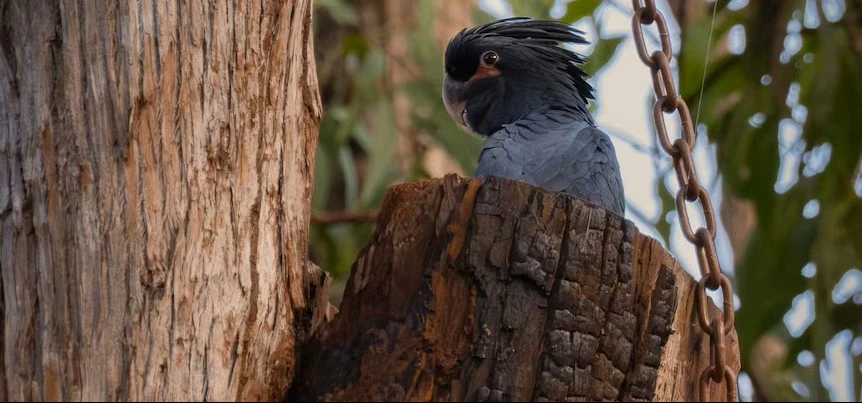
The outlook is becoming much more hopeful for one of Australia’s most striking and unusual cockatoos, a species whose survival depends on extremely rare nesting conditions.
Experts explain that creating the perfect nest for a palm cockatoo is no simple matter. It can take around 250 years, along with termite activity, the absence of destructive wildfires, and even cyclone damage, for the right tree hollow to form. As land clearing continues, those already uncommon conditions are becoming even harder to find.
Conservationists with People for Wildlife have now made an important breakthrough. After years of trial and research, they have successfully developed artificial nesting hollows that palm cockatoos are willing to use.
Researcher Christina Zdenek described the achievement as a major milestone, explaining that the species is highly threatened and has been declining rapidly, which made finding a workable nesting solution especially important.
Palm cockatoos live in Far North Queensland, Australia’s northernmost state. They are large birds, measuring well over a foot in length, and are instantly recognizable by their dark plumage, dramatic crest, vivid red cheek patch, and massive black beak. They are also famous for their unusual behavior during courtship, when they use sticks to drum rhythmic beats on hollow trees — a habit that has earned them the nickname “the Ringo bird.”
Fewer than 2,000 palm cockatoos are believed to remain. Their nesting needs are one reason the species is so vulnerable. They rely on hollows that form in old trees after long periods of decay caused by termites or fungi, often combined with storm damage from cyclones. Logging and increasingly intense fires have disrupted this slow natural process, leaving the birds with fewer suitable places to breed.
To address the problem, People for Wildlife partnered with a skilled woodcarver to create what they call the “Palm Cockatube.” Made from sections of old-growth tree trunks, these man-made hollows were shaped to closely resemble the natural nesting spaces the birds prefer.
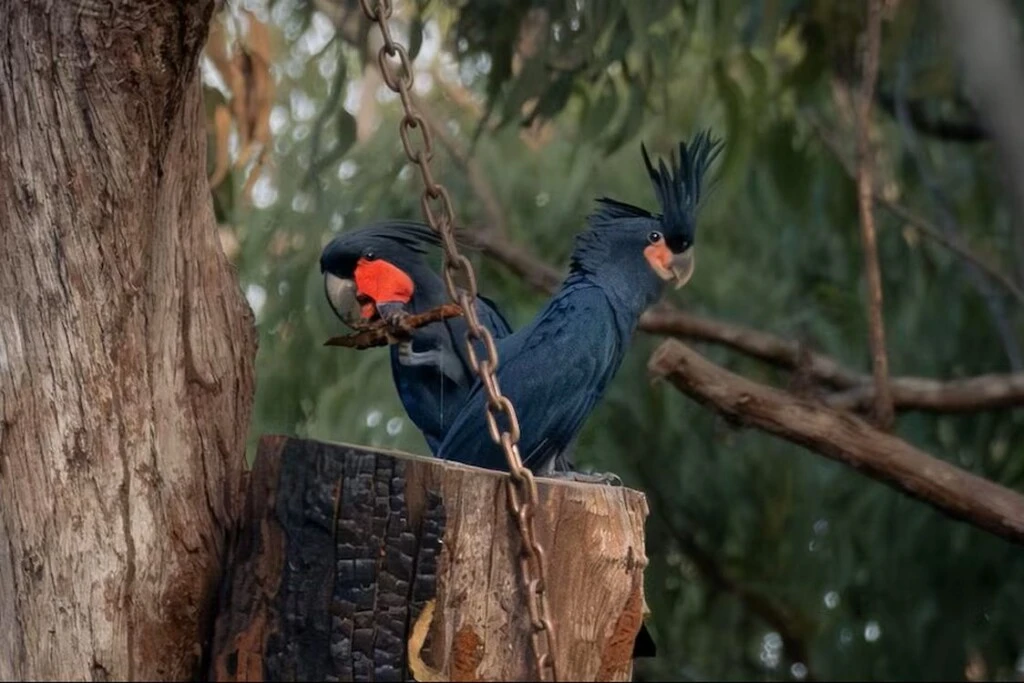
The team installed 29 artificial nests in key areas where palm cockatoos were known to live, though not actively breeding. The nests were created in three different styles to test which design the birds might accept.
Their efforts paid off. Last September, Zdenek and fellow researcher Benjamin Muller noticed adult cockatoos repeatedly visiting one of the artificial hollows. Later, they found an egg inside, and more recently, that egg hatched — an exciting success for both the researchers and the Apudthama Traditional Owners.
The implications go beyond just one species. In Australia, tree hollows provide shelter for many animals, not only cockatoos. Zdenek believes that if palm cockatoos accept these artificial nesting sites, other hollow-dependent wildlife, including gliders and other arboreal species, may benefit too.
She noted that palm cockatoos serve as an umbrella species in the region, meaning that protecting them can also help protect many other animals that share the same habitat.