

Scientists have only documented this behavior twice 😱
An Unexpected Encounter Beneath the Surface
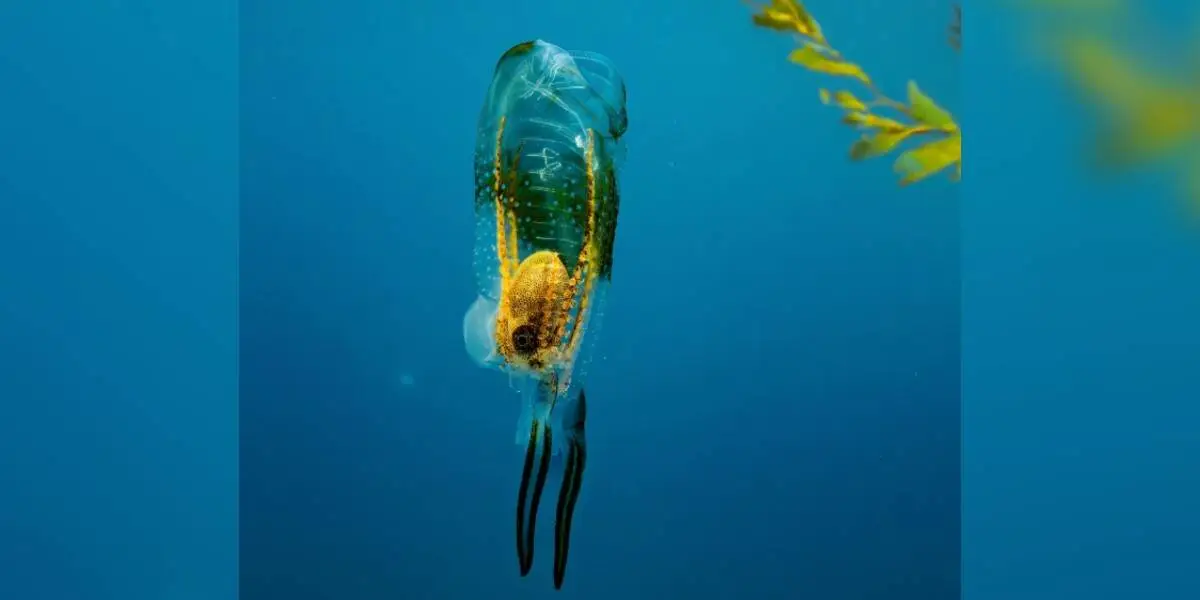
Last month, underwater photographer Henry Cooper was free-diving in the waters off Southern California when something strange drifted into view. At first, the creature looked like a translucent squid, with a clear outer body and a glowing orange center.
Two Animals, Not One
As Cooper moved closer, he quickly realized the “squid” wasn’t a squid at all. Instead, it was two animals combined — a tuberculate octopus tucked neatly inside the hollow body of a salp.
“At first glance, it looks like a squid,” Cooper explained on Instagram, “but it’s actually an octopus using a jelly-like salp as a drifting mobile home.”
What Exactly Is a Salp?
While octopuses are familiar to most people, salps remain largely unknown. These gelatinous marine animals live throughout the world’s oceans and survive by filtering microscopic food from the water. Their transparent, barrel-shaped bodies allow them to move by pumping water through themselves, effectively jetting through the sea.
A Rarely Documented Behavior
Though Cooper was knowledgeable about both species, he had never witnessed an octopus living inside a salp. Curious, he looked into scientific research and was stunned by how uncommon the behavior is.
“This species lives in the open ocean rather than on reefs, where divers typically explore,” Cooper wrote. “In 16 years of Mediterranean research, scientists recorded only two sightings.”
Why Take Shelter Inside a Salp?
The reason behind this behavior remains a mystery. Scientists believe the octopus may benefit from the salp’s efficient movement, using it as a means of transportation. Another theory suggests the salp provides camouflage or protection from predators — but none have been confirmed.
“Protection? Camouflage? A free ride?” Cooper wrote. “No one really knows. It’s been observed so rarely that there just isn’t enough data.”
Size Matters
Researchers do know that only juvenile and adult male tuberculate octopuses are capable of living inside salps. Adult males grow to about 10 inches long, while females can exceed 3 feet, making them far too large to fit within a salp’s body.
A Once-in-a-Lifetime Moment
Scientists hope future research will shed more light on this unusual partnership. For Cooper, the sighting was unforgettable.
“I’m still trying to wrap my head around it,” he wrote — grateful to have witnessed such a rare and extraordinary moment in the wild.