
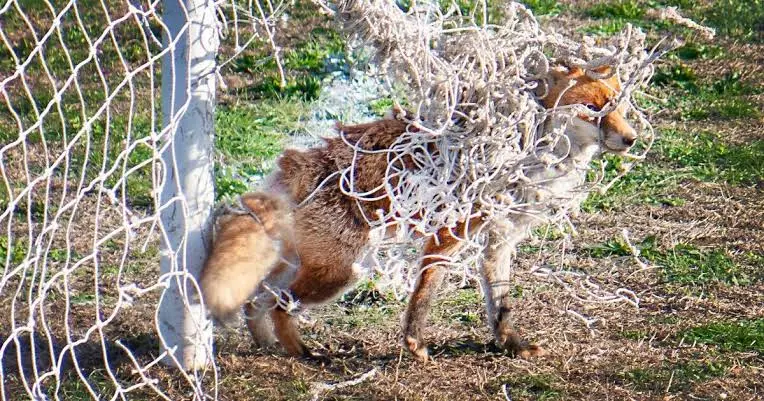
Wildlife rescuers in England thought they were responding to a familiar emergency when they received a call about a fox trapped in a soccer net. But when they arrived, they discovered an unusually large animal struggling to free himself from the tangled mesh.
The rescue was challenging enough on its own. However, nobody expected that just two days after the fox returned to the wild, his mate would end up caught in the exact same net.
What began as a routine wildlife rescue quickly turned into an extraordinary story involving two foxes, one dangerous net, and a dedicated team determined to save them both.
An Ordinary Rescue Call Reveals an Extraordinary Fox
The team at South Essex Wildlife Hospital is no stranger to rescuing animals caught in abandoned or improperly stored sports nets.
Over the years, its experienced wildlife rescuers have helped countless creatures escape dangerous situations caused by tangled netting.
So when another call came in about a fox trapped in a soccer net, the team knew what to expect.
Or at least, they thought they did.
Upon arriving at the scene, rescuers were astonished by the size of the animal waiting for them.
The fox weighed more than 20 pounds, making him one of the largest foxes the team had ever encountered.
But despite his impressive size and strength, he was completely helpless against the net that had trapped him.
As the frightened animal struggled to escape, the thin strands became increasingly tangled around his body.
Before long, the netting had tightened around his neck, legs, and torso, restricting his movements and leaving him unable to free himself.
Each attempt to escape risked making the situation worse.
The rescuers knew they needed to act carefully to prevent further injury.
A Dangerous Tangle Leaves the Fox Injured
Freeing the enormous fox required patience and precision.
The mesh had become wrapped tightly around several parts of his body, meaning rescuers couldn’t simply pull him loose.
Instead, they carefully worked to remove the netting while minimizing the risk of causing additional harm.
Eventually, their efforts paid off.
The fox was freed from the tangled material, but his ordeal wasn’t over.
The struggle had left him with injuries that required professional veterinary care.
His rescuers transported him to South Essex Wildlife Hospital, where staff examined him and began providing treatment.
The injured fox was placed on medication to support his recovery and remained under the hospital’s care while his wounds healed.
Over time, his condition improved.
The team continued monitoring him until he had recovered sufficiently to return to his natural habitat.
Finally, after receiving the treatment and attention he needed, the unusually large fox was released back into the wild.
For his rescuers, it was the outcome they had been hoping for.
They had saved a vulnerable animal, helped him recover, and returned him to the place where he belonged.
But the story was about to take an astonishing turn.
Just Two Days Later, His Mate Gets Trapped in the Same Net
Only two days after the male fox was released, South Essex Wildlife Hospital received another distressing call.
A fox had become tangled in a soccer net and needed urgent assistance.
When rescuers arrived, they discovered something almost unbelievable.
The animal was a female fox they recognized as the recently rescued male’s mate.
Even more surprisingly, she had become trapped in the exact same net that had nearly cost her partner his life.
It was an extraordinary and deeply concerning coincidence.
Like her mate before her, the female fox had become caught in the mesh and was unable to escape without help.
The netting that had already injured one animal was now threatening another.
Once again, the rescue team had to carefully cut through the tangled material to free the trapped fox.
After successfully removing her from the net, they transported her to the wildlife hospital for treatment.
The situation was frustrating for everyone involved.
Just days earlier, the team had celebrated returning the male fox to his natural environment. Now, they were caring for his injured mate after an almost identical accident.
Two foxes from the same pair had fallen victim to the same preventable hazard.
The Female Fox Begins Her Recovery
Following her rescue, the female fox was admitted to South Essex Wildlife Hospital to receive veterinary care.
Much like her mate, she needed treatment for injuries caused by becoming tangled in the soccer net.
The hospital began providing the appropriate medication and monitoring her recovery.
Although the situation was upsetting, the team remained hopeful that she would heal and eventually be able to return to the wild.
Her partner had already demonstrated that recovery was possible with proper treatment and care.
Now, rescuers hoped the female fox would have the same opportunity.
At the time of the hospital’s update, she was still receiving treatment, and her release had not yet been confirmed.
The team wanted nothing more than to see her healthy enough to return to her familiar territory and reunite with her mate.
But beyond helping the injured animal recover, the incident raised an important concern about the dangers wildlife face from everyday objects left outdoors.
Why Unattended Soccer Nets Are So Dangerous to Wildlife
The two fox rescues highlighted a hazard that many people may not immediately recognize.
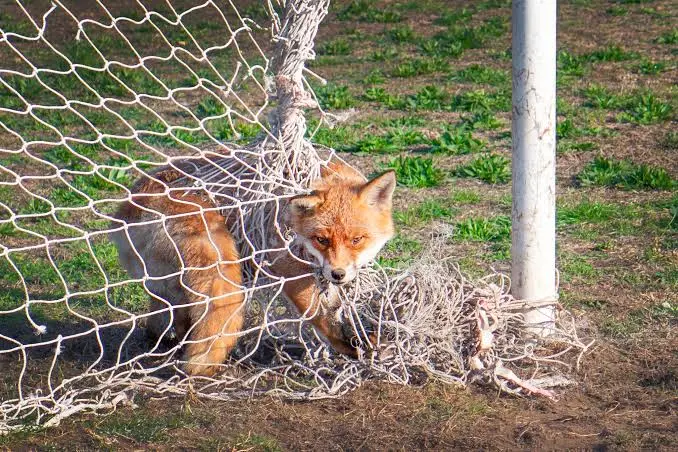
Soccer nets, garden netting, and similar materials can become dangerous traps for wild animals when left unattended.
Foxes and other wildlife may approach these objects while exploring their surroundings, searching for food, or moving through familiar territory.
Once an animal becomes entangled, its instinctive attempts to escape can cause the mesh to tighten around its body.
This can lead to painful injuries, restricted movement, and potentially life-threatening complications.
Even a large, powerful animal like the male fox rescued by South Essex Wildlife Hospital can be completely immobilized by tangled netting.
The hospital used the incidents to remind the public that simple precautions can prevent serious wildlife emergencies.
Its advice was clear: unattended sports nets should be properly stored or raised at least 30 centimeters above the ground when not in use.
Removing or securing nets after recreational activities can help protect animals that pass through the area.
For the two foxes, the consequences of leaving the same net accessible were particularly serious.
Both animals required rescue and veterinary treatment because of a hazard that could have been prevented.
Two Lives Saved by Dedicated Wildlife Rescuers
Despite the distressing circumstances, the story of the two foxes also demonstrates the importance of wildlife rescue organizations.
South Essex Wildlife Hospital’s team responded to both emergencies, carefully freed the trapped animals, and provided the medical care they needed.
Their efforts allowed the male fox to recover and return to the wild, while giving his mate the opportunity to receive treatment for her injuries.
The unusual series of events left rescuers with a story they were unlikely to forget.
Saving one exceptionally large fox from a soccer net was already memorable.
Discovering that his mate had become trapped in the same net just two days after his release made the situation even more remarkable.
And while the rescue team remained hopeful about the female’s recovery, the incidents served as an important reminder that everyday human activities can have unexpected consequences for wildlife.
A simple soccer net might seem harmless when nobody is using it. But for a curious fox wandering through its natural habitat, it can quickly become a dangerous obstacle.
Thanks to the dedicated rescuers who stepped in, both animals were given a chance to recover.
Now, the hope is that the female fox will soon return to the wild, where her mate is already waiting somewhere in their shared territory — and that neither will ever have to face another tangled net again.