

It’s an amazing sign for biodiversity.
Deep inside the lush rainforests of West Africa, a remarkable discovery has given wildlife researchers a renewed sense of hope.
For more than a decade, a beautiful and extremely rare bird known as the Ghana cuckooshrike had remained absent from confirmed scientific records. Despite its striking colors, the mysterious species seemed to have vanished into the dense forest canopy.
Some researchers feared that habitat destruction and declining populations might have pushed the bird dangerously close to extinction.
But in June 2026, two conservation researchers exploring a protected forest in Côte d’Ivoire experienced a moment they would never forget.
High above them, among the tangled branches and leaves, something colorful suddenly moved.
What happened next resulted in the first confirmed documentation of the species in 13 years — along with what is believed to be its first-ever video recording.
A Flash of Color in the Trees Reveals a Remarkable Surprise
Stephanie Bartlett and Paulo Ditzel, field researchers working with the International Bird Conservation Partnership, were approaching the end of an extensive six-month expedition across West Africa.

Their work involved searching for and documenting birds in remote forest habitats, including species that scientists rarely encounter.
One of their destinations was Taï National Park, a vast protected rainforest in southwestern Côte d’Ivoire.
The park is home to an extraordinary variety of wildlife, making it an important refuge for animals threatened by habitat loss elsewhere in the region.
Although the researchers knew the Ghana cuckooshrike had historically lived in the area, they understood that the chances of seeing one were extremely small.
The bird had not been reliably documented since 2013.
Then, during an afternoon outing in the forest, everything changed.
As Bartlett and Ditzel crossed a small bridge, they noticed movement high among the branches.
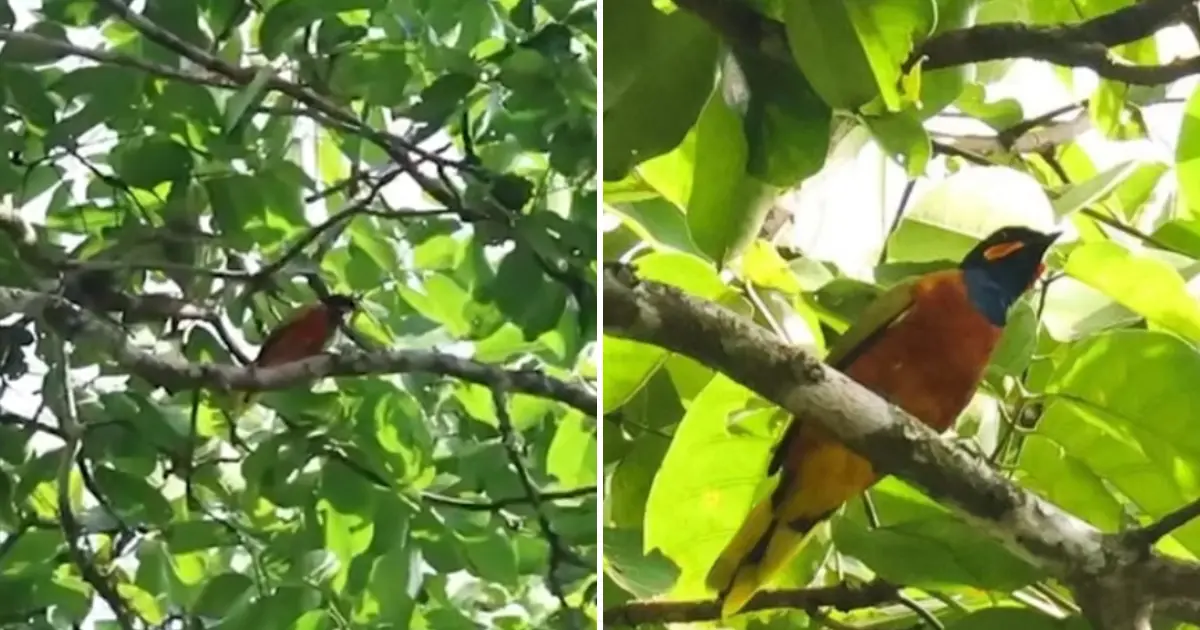
A glimpse of vivid orange, yellow, and black plumage immediately attracted their attention.
They looked more closely.
There, partially concealed by thick foliage, was a bird they had hoped to encounter but never realistically expected to find.
It was a Ghana cuckooshrike.
After 13 years without a confirmed record, the elusive species had appeared directly above them.
Researchers Capture Rare Photos and the Bird’s First Known Video
Recognizing the significance of the discovery, the researchers moved quickly.
Ditzel used his binoculars to follow the bird’s movements through the branches, helping Bartlett locate it with her camera.
Their teamwork was crucial.
In a dense rainforest, even brightly colored birds can disappear behind leaves within seconds. A brief change of position can mean the difference between documenting an important sighting and losing the opportunity entirely.
Bartlett began taking photographs while tracking the bird as it moved through the canopy.
She also managed to record video footage.
The images provided the first confirmed photographic documentation of the Ghana cuckooshrike since 2013.
Even more remarkably, the recording is believed to be the first video ever captured of the species.
The bird eventually disappeared among the branches, but the encounter wasn’t quite over.
It briefly appeared again and was observed catching a pale caterpillar before vanishing back into the forest.
The researchers continued searching afterward, but the rare visitor proved just as difficult to locate as before.
Fortunately, they had already captured the evidence they needed.
Their photographs and video confirmed that a species missing from documented observations for more than a decade was still surviving in the forests of West Africa.
Why Did the Ghana Cuckooshrike Disappear for So Long?
The Ghana cuckooshrike, scientifically known as Lobotos lobatus, is also called the western wattled cuckooshrike.
It inhabits the tropical forests of West Africa, particularly areas with tall trees and dense upper canopies.
Males are especially distinctive, displaying colorful combinations of orange, yellow, black, and chestnut plumage.
Despite its striking appearance, the species can be incredibly difficult to observe.
These birds spend much of their time high above the forest floor, often concealed by thick vegetation.
Their elusive behavior, combined with limited scientific surveys in some remote habitats, makes locating them challenging.
But their rarity isn’t simply a matter of being difficult to see.
The Ghana cuckooshrike faces serious threats from the destruction of its natural environment.
Over several decades, extensive logging, agricultural expansion, and forest clearing have dramatically changed the landscapes where the species once lived.
Large areas of continuous rainforest have been reduced to isolated patches, making survival increasingly difficult for wildlife that depends on forest habitats.
As these environments have disappeared, records of the Ghana cuckooshrike have become less frequent.
The species is currently classified as Vulnerable on the International Union for Conservation of Nature’s Red List.
Its continued survival remains a major concern for conservationists.
A Species Once Considered Lost to Science
The Ghana cuckooshrike’s long absence attracted particular attention through an international conservation initiative known as Search for Lost Birds.
The project focuses on bird species that have gone at least 10 years without reliable documentation.
In 2024, the initiative identified 126 bird species that had effectively disappeared from confirmed scientific observations.
Some had remained undocumented for decades, while others had not been reliably recorded for more than a century.
The Ghana cuckooshrike was among these missing species.
Its last confirmed photographic record had come from Ghana’s Atewa Forest in 2013.
As the years passed without new documentation, questions grew about whether viable populations were still surviving in their historical habitats.
However, being classified as lost to science doesn’t necessarily mean a species is extinct.
Some animals remain undetected because they inhabit remote environments, have extremely small populations, or are difficult to observe.
The Ghana cuckooshrike’s rediscovery illustrates exactly why scientists continue searching for these elusive creatures.
Even after years of uncertainty, important wildlife populations may still be surviving in places where suitable habitat remains.
The Rediscovery Brings New Hope for Rainforest Conservation
For conservationists, the significance of the discovery extends beyond the excitement of photographing an incredibly rare bird.
It also highlights the importance of protecting the forests that allow threatened wildlife to survive.
Taï National Park is one of the most important remaining strongholds of the Upper Guinean rainforest ecosystem.
Its protected forests provide habitat for numerous animal species, including some that have become increasingly difficult to find elsewhere.
However, even protected areas face environmental pressures.
Illegal hunting, mining activities, and the continuing loss of surrounding forests create challenges for wildlife conservation.
The return of the Ghana cuckooshrike to confirmed scientific records offers evidence that the species continues to exist in this threatened ecosystem.
Researchers hope the discovery will draw greater attention to the need for habitat protection, additional population surveys, and long-term conservation programs.
Yendoubouam Kourdjouak, the International Bird Conservation Partnership’s West Africa project manager, viewed the sighting as an encouraging sign for the region’s biodiversity.
The discovery confirmed that the bird had not disappeared completely and reinforced the importance of protecting Taï National Park.
Still, scientists recognize that observing a single individual doesn’t necessarily mean the wider population is recovering.
More research will be needed to understand how many Ghana cuckooshrikes remain and what can be done to secure their future.
One Extraordinary Encounter Offers a Reason to Keep Searching
The story of the Ghana cuckooshrike is a reminder of how much remains unknown about the wildlife living in Earth’s most remote forests.
For 13 years, the bird had been missing from confirmed scientific records.
Researchers knew it might still exist, but finding proof was another challenge entirely.
Then, during a brief encounter among the towering trees of Taï National Park, two dedicated researchers managed to document something extraordinary.
Their discovery required patience, experience, teamwork, and a fortunate moment in the right place.
It also demonstrated why continued field research matters.
Without scientists returning to difficult-to-reach habitats, rare species can remain overlooked, leaving conservation organizations with limited information about their survival.
Now, thanks to Bartlett and Ditzel’s photographs and video, researchers have renewed evidence that the Ghana cuckooshrike still inhabits West Africa’s forests.
The images may also help raise awareness of an extraordinary species that few people have ever had the opportunity to observe.
Its future remains uncertain, but its rediscovery offers a powerful reason to continue protecting the places where it lives.
And perhaps, as conservation efforts continue and researchers return to the rainforest, the next sighting won’t require another 13 years of searching.
Sometimes, nature’s greatest surprises aren’t the discovery of something entirely new, but the return of something precious that the world feared it might have lost forever.