

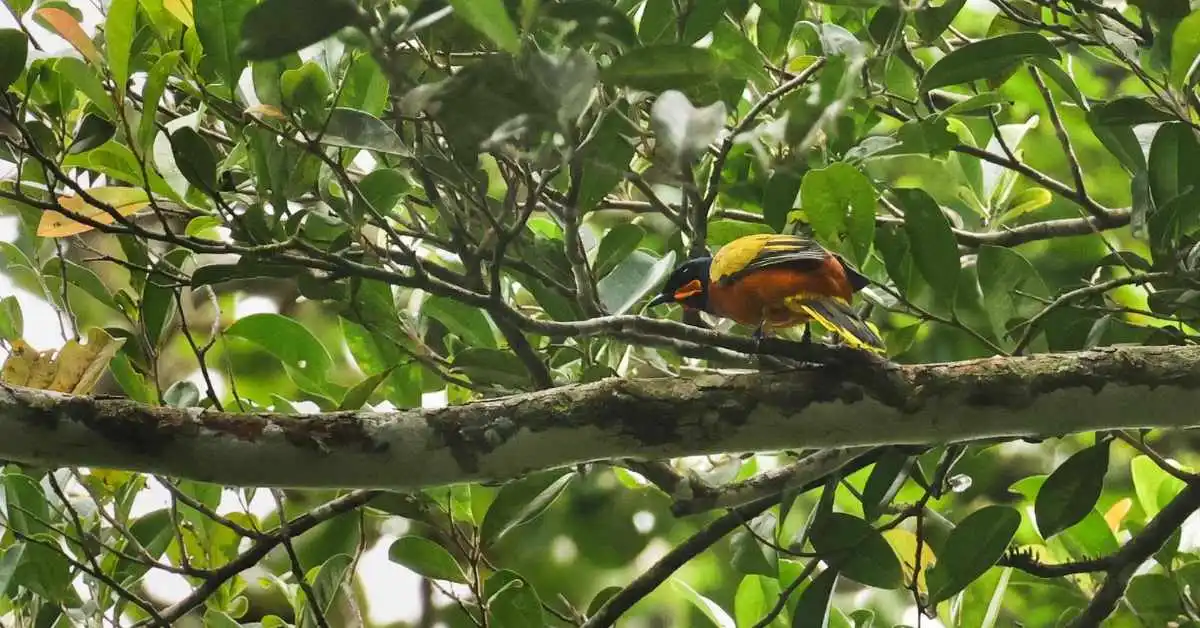
Researchers Paulo Ditzel and Stephanie Bartlett were exploring Taï National Park when they unexpectedly spotted the Ghana cuckooshrike.
The bird immediately caught their attention with its striking orange body, yellow and black wings, dark head and distinctive copper-coloured facial markings.
Ditzel recognised the species and quickly directed Bartlett’s attention toward the bird.
Using her camera, Bartlett successfully photographed the animal before it disappeared into the forest canopy.
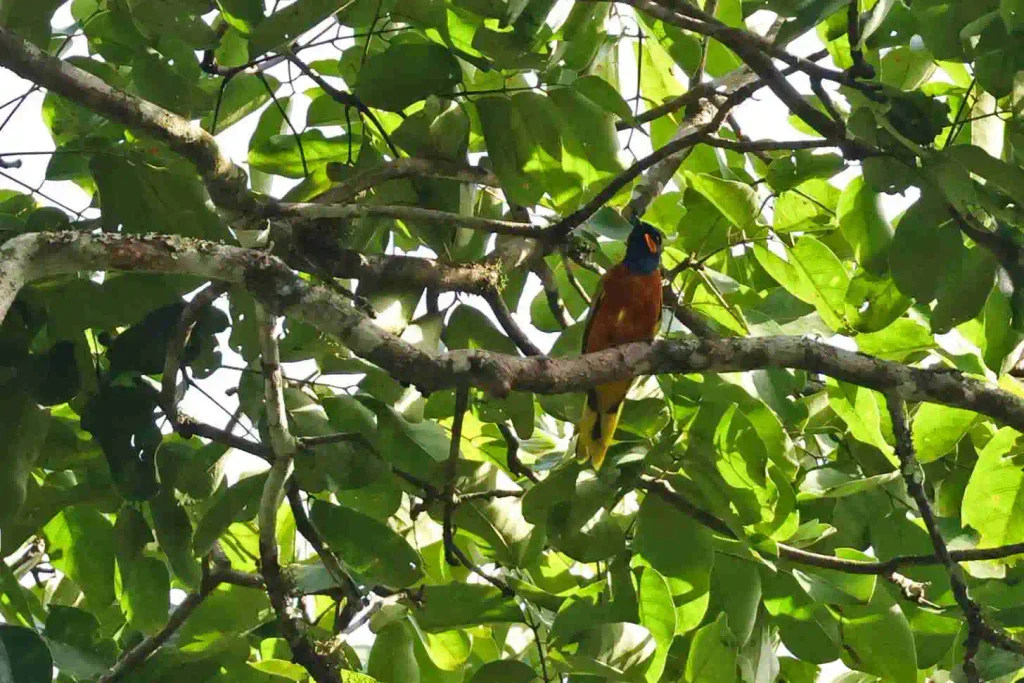
The discovery was especially significant because the last verified sighting of the Ghana cuckooshrike had occurred in Ghana’s Atewa Forest in 2013.
The photographs provided important new evidence that the species was still present in West Africa.
What Makes the Ghana Cuckooshrike Special?
The Ghana cuckooshrike is a colourful but rarely observed bird found in West Africa’s Upper Guinean rainforest.
Although its bright plumage makes it visually distinctive, the species is difficult to locate because it spends much of its time high in the forest canopy.
Its behaviour, population size and exact distribution remain poorly understood.
Key Facts About the Ghana Cuckooshrike
| Category | Information |
|---|---|
| Common name | Ghana cuckooshrike |
| Scientific name | Lobotos lobatus |
| Alternative name | Western wattled cuckooshrike |
| Natural habitat | West African tropical rainforests |
| Previous confirmed sighting | 2013 |
| Rediscovery | June 2026 |
| Rediscovery location | Taï National Park, Côte d’Ivoire |
| Main threats | Deforestation and habitat fragmentation |
The species is associated with rainforest environments stretching across parts of Sierra Leone, Guinea, Côte d’Ivoire and Ghana.
However, increasing habitat destruction has made protecting these forests more important than ever.
How Researchers Rediscovered the Missing Bird
The discovery occurred during a research expedition organised with support from the International Bird Conservation Partnership.
Ditzel and Bartlett had spent six months conducting bird surveys across four West African countries.

While exploring Taï National Park, they encountered the Ghana cuckooshrike moving through the forest canopy alongside several other bird species.
The researchers quickly documented the sighting using photographs and video.
At one point, the bird disappeared into the surrounding vegetation. However, it briefly returned and was observed catching a caterpillar.
Despite additional searches the following day, the research team was unable to locate it again.
Nevertheless, the photographs and field observations provided valuable information about a bird that scientists had not officially documented for more than a decade.
Why Had the Ghana Cuckooshrike Disappeared?
The Ghana cuckooshrike’s absence from scientific records does not necessarily mean that the species had disappeared from the wild.
Several factors can make rare birds particularly difficult to find.

The Ghana cuckooshrike spends much of its time high in the rainforest canopy, where dense vegetation makes observation challenging.
Limited scientific research in parts of West Africa may also contribute to gaps in existing wildlife records.
At the same time, habitat destruction presents a serious conservation concern.
Logging, agriculture and other human activities have reduced and fragmented the Upper Guinean rainforest, leaving many wildlife populations in increasingly isolated forest areas.
Major Threats to West African Rainforests
| Threat | Environmental impact |
|---|---|
| Deforestation | Destroys natural wildlife habitats |
| Agricultural expansion | Reduces forest coverage |
| Illegal mining | Damages forests and surrounding ecosystems |
| Illegal hunting | Places additional pressure on wildlife |
| Habitat fragmentation | Separates forests and wildlife populations |
These environmental pressures threaten not only the Ghana cuckooshrike but also numerous other species that depend on West Africa’s tropical forests.
The Importance of Taï National Park
Taï National Park is one of West Africa’s most important remaining rainforest ecosystems.
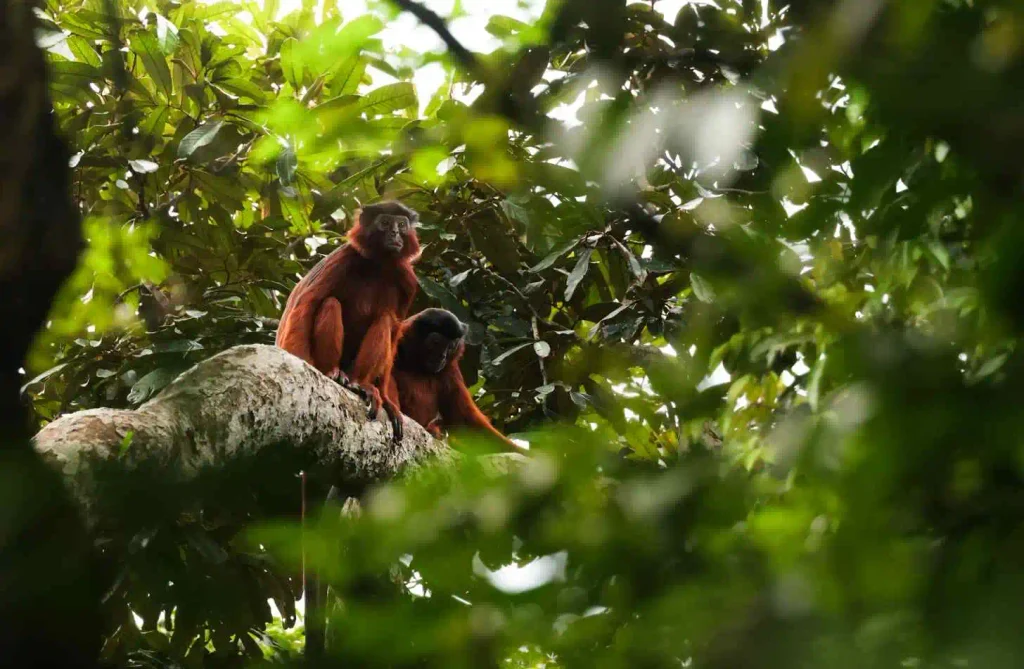
Located in Côte d’Ivoire, the protected area provides habitat for numerous animal species, including rare birds and threatened primates.
Its extensive forest environment creates opportunities for wildlife research and biodiversity conservation.
However, the park continues to face environmental challenges, including illegal gold mining and hunting.
The rediscovery of the Ghana cuckooshrike demonstrates the importance of preserving protected forests where rare and poorly understood species may still survive.
Researchers believe that continued monitoring and habitat protection are essential for understanding the bird’s population and improving its long-term conservation prospects.
International Teamwork Makes the Discovery Possible
The rediscovery was made possible through cooperation between international researchers and West African conservation specialists.
Local scientists, park rangers and project coordinators played essential roles in organising the expedition, navigating difficult terrain and connecting researchers with nearby communities.
Their knowledge and experience helped the team reach remote research locations.
The expedition also highlighted the importance of strengthening scientific partnerships and supporting wildlife research in regions where biodiversity remains poorly documented.
Continued cooperation will be essential for future research into the Ghana cuckooshrike and other rare West African birds.
The Search for Lost Birds
The Ghana cuckooshrike was among the species highlighted by the Search for Lost Birds initiative.
Established in 2021, the international partnership brings together conservation organisations to help locate bird species that have not been scientifically documented for at least 10 years.
Its partners include the American Bird Conservancy, BirdLife International and Re.
The initiative encourages researchers, birdwatchers and conservation organisations to share information about rarely observed species.
Modern technology, including digital photography and bird identification applications, has made it easier for both professional researchers and amateur birdwatchers to contribute valuable wildlife observations.
As of September 2026, approximately 114 known bird species had not been documented for at least a decade.
Rediscovering these species helps conservationists determine where they survive and identify the habitats that require protection.
What Happens Next for the Ghana Cuckooshrike?
Although the discovery confirms that the Ghana cuckooshrike still survives, many questions remain unanswered.
Scientists still need more information about its population size, distribution, feeding behaviour and habitat requirements.
Additional fieldwork could help researchers identify other locations where the species may live.
The expedition team also hopes to return to West Africa to continue its research and strengthen partnerships with local conservation specialists.
Protecting Taï National Park and other remaining rainforest habitats will play an important role in ensuring the species’ survival.
Conclusion
The rediscovery of the Ghana cuckooshrike after 13 years is an encouraging development for wildlife conservation in West Africa.
The remarkable sighting demonstrates that rare species can survive in remote environments even after disappearing from scientific records for many years.
However, the discovery also highlights the growing threats facing tropical rainforests and the wildlife that depends on them.
Continued scientific research, international cooperation and effective habitat protection will be essential for understanding and conserving the Ghana cuckooshrike.
Its rediscovery offers hope that other missing bird species may still be waiting to be found.