

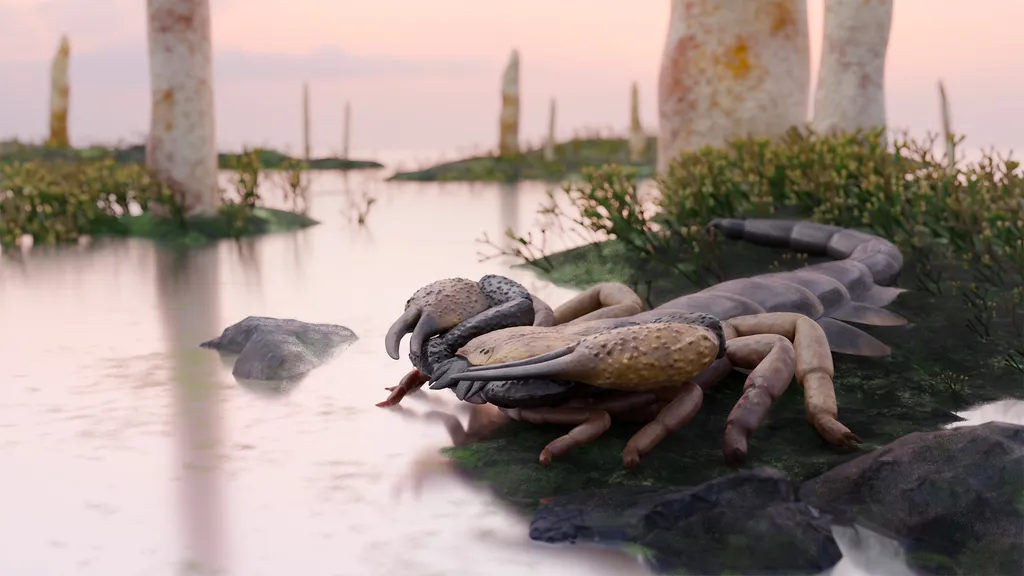
The largest scorpion currently known to science lived about 415 million years ago in what is now the United Kingdom, according to a new study. At that time, most land animals were still small, making this ancient predator unusually massive for its environment.
The extinct species, called Praearcturus gigas, may have reached about 3.3 feet, or 1 meter, in length. It also had powerful pincers that measured around 6.2 inches, or 16 centimeters, long. Researchers say these features would have made it a dominant predator on Early Devonian floodplains.
During this period, life on land was still developing. Terrestrial ecosystems were not yet complex, and forests had not appeared. Small arthropods were among the main land-dwelling animals. Arthropods remain the most diverse animal group today and include insects, spiders, scorpions, and crustaceans.
The discovery suggests that scorpions were able to evolve giant body sizes much earlier than scientists had clearly confirmed. It also provides new clues about how arthropod gigantism developed during Earth’s ancient past.
Richard Howard, curator of fossil arthropods at the Natural History Museum in London and lead author of the study, said that identifying Praearcturus as a true scorpion changes scientists’ understanding of when these animals first reached such remarkable sizes.
Fossils of P. gigas have been found in England and Wales. They were first described in the 1870s, but for more than a century, researchers disagreed about what kind of animal they represented.
At first, some scientists thought the fossils belonged to a large crustacean similar to a woodlouse. In the 1980s, others proposed that the remains were from a scorpion. That idea was later questioned because the fossils were incomplete and did not preserve the familiar scorpion tail.
In the new study, published on June 2 in the journal Palaeontology, researchers reexamined important P. gigas fossils from the Natural History Museum’s collections. They used modern imaging and analytical methods and compared the remains with other ancient animals that had already been more securely identified as scorpions.
Their results support the idea that Praearcturus gigas was indeed a scorpion. The team also assigned several additional fossils from the same geological formation to the species.
The researchers believe the animal may have lived partly in water. Some fossils show flap-like structures called epimera, which resemble features that help support and protect the hard upper shells of animals such as lobsters and crabs.
A semi-aquatic lifestyle may help explain why this scorpion grew so large. Water can support bigger bodies more easily than land. Its size may also have been possible because there were few large land predators competing with it at the time.
According to the researchers, Praearcturus is especially important because it became enormous in a world where most land animals were still tiny. Its existence shows that Early Devonian environments could support a giant predator much earlier than previously understood.
By combining fossil material from different collections with advanced imaging techniques, scientists were able to form a clearer picture of this long-debated animal. The study reveals that ancient land ecosystems, though still simple, were already capable of producing impressive and formidable predators.