
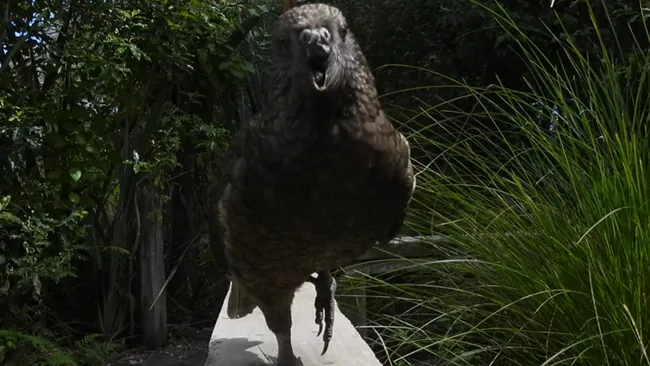
A kea parrot in New Zealand who lost the top part of his beak when young has developed a new way to fight other males that has made him unbeatable.
In the animal kingdom, physical disadvantage rarely leads to the top of the social ladder. Bruce, a New Zealand kea parrot, didn’t get that memo. Despite being missing the entire upper half of his beak, Bruce has fought his way to alpha male status in his group — and done it entirely on his own terms. Scientists say it’s the first known case of a physically impaired animal achieving dominance without the help of alliances or outside support.
The Jousting Technique Nobody Else Could Replicate
Rather than accepting his limitations, Bruce invented something entirely new. During social jousts — competitive confrontations used to establish rank — he thrusts his exposed lower beak at opponents, targeting their heads, wings, beaks and legs. The moves are rarely about making contact. Instead, they are calculated acts of intimidation, designed to unsettle and dominate.
Depending on the distance, Bruce adapts his approach. Up close, he extends his neck to maximise force. From farther away, he runs and leaps, driving his beak forward in a move that no intact parrot could physically replicate — because in a normal kea, the upper beak protrudes over the lower one, making the technique impossible.
The results speak for themselves. Bruce’s jousting immediately displaced opponents 73% of the time, and across 36 observed jousts, he won every single one.
“We know his jousting is a huge part of his success,” said Alex Grabham, a biologist at the University of Canterbury in New Zealand and lead author of the study, published in the journal Current Biology.
A Life Built on Innovation
Bruce has lived at Willowbank Wildlife Reserve in Christchurch for around 12 years, after being found as a juvenile in the mountains of New Zealand’s South Island — already missing his upper beak. How it happened remains unknown, though researchers suspect an accident of some kind early in his life.
What followed, however, is a remarkable story of adaptation. Unable to use his beak for grooming, Bruce developed an entirely novel solution — he uses pebbles of different sizes to preen himself, marking the first ever recorded case of self-care tool use in a kea parrot.
“It’s no surprise that a bird like Bruce, that has this impairment, has had to innovate and get on with his life,” Grabham said.
The Rewards of the Top Spot
Being alpha has tangible benefits, and Bruce enjoys all of them. He has the lowest stress hormone levels in the group — confirmed through analysis of fecal samples — and enjoys first access to feeders. He is also the only male in the group to be preened and have his beak cleaned by other males, a sign of his elevated standing.
What Makes Bruce Truly Remarkable
In other documented cases of physically impaired animals rising to the top of their social groups, alliances were the key ingredient. One chimpanzee who lost the use of his arm due to polio climbed the ranks through a bond with his brother. An older Japanese macaque who lost his ability to walk relied on an alliance with the group’s alpha female. Bruce had none of that. He got there alone, through sheer ingenuity.
Why His Story Matters Beyond the Reserve
Kea are an endangered species, with fewer than 7,000 individuals remaining in the wild. Their survival depends on conservation efforts like the breeding programs and education initiatives run by Willowbank Wildlife Reserve. Bruce’s story, researchers say, is a vivid testament to the intelligence and adaptability that makes kea worth fighting to protect.
“All of the kea are unique and have their own ways and personalities,” Grabham said. “They’re incredible creatures, and Bruce is one of many.”