

Here’s the rewritten version with engaging language, subheadings, and all Dodo references removed:
Three Orcas Just Showed Up in Seattle Waters — And Scientists Have No Idea Why
Strangers in Familiar Waters
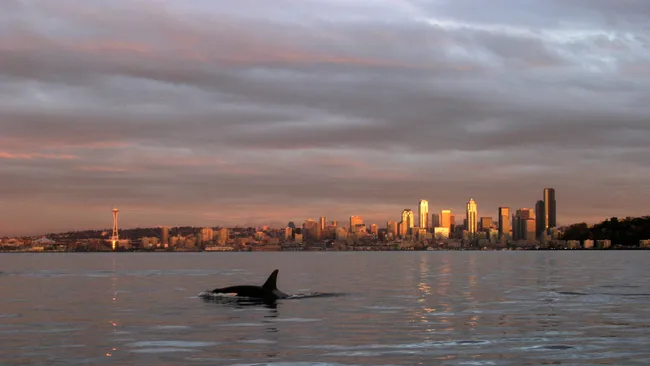
In March, something deeply unusual happened in the shimmering stretch of water between Washington state and Canada. Three orcas surfaced in the area — and nobody had ever seen them there before. What made their appearance even more puzzling was where they had come from: Alaska, some 1,500 to 2,000 miles away.
“It’s extremely rare to have previously undocumented killer whales show up in local waters, so it’s been very exciting to see them, and right now we have more questions than answers,” said Monika Wieland Shields, director of the Orca Behavioral Institute, a Seattle-based non-profit research organization.
Who Are These Whales?
The pod appears to consist of three individuals — likely a mother and her two offspring, one of which is a fully grown male. Researchers were able to identify the group by cross-referencing distinctive markings on their fins and unique side colorations, a technique that has been refined over decades of careful study. Matching those markings to photographs taken in Alaska last year confirmed just how far they had traveled.
A Species Creatures of Habit
What makes this sighting so striking is how unusual it is for orcas to stray this far from familiar territory. Killer whales are creatures of deep habit — they tend to travel within established ranges and return to the same hunting grounds year after year, sometimes across generations. A pod appearing this far outside its known range is a significant event, one that suggests something may have shifted.
A Sea in Flux
The waters of the Salish Sea are already in the middle of a dramatic ecological reshuffling. Two distinct groups of orcas have long called the region home: the endangered, fish-eating Southern Resident killer whales, and the mammal-eating Bigg’s killer whales. But their presence and patterns have been changing rapidly.
“The Southern Residents no longer have abundant, reliable wild salmon to feed on here, so they’ve shifted their travel patterns elsewhere,” Wieland Shields explained. “Bigg’s killer whales are here in ever-increasing numbers because the populations of their primary prey in the region — harbor seals, harbor porpoises and Steller sea lions — are all booming.”
The three new arrivals have been identified as Bigg’s killer whales, and experts believe food may be the driving force behind their extraordinary journey south.
Following the Food?
Heather Hill, a psychologist specialising in marine mammal behaviour at St. Mary’s University in San Antonio, agrees that prey availability is likely a key factor.
“They can be indicators of the health of an area — the whole food chain idea,” Hill said. “Studying the different pods also helps us understand their social dynamics, such as how they share the same space with other transients or residents.”
More Questions Than Answers
For now, the mystery remains very much unsolved. Researchers don’t yet know exactly which Alaskan population the pod belongs to, how long they intend to stay, or what ultimately drew them so far from home. Acoustic and genetic testing may eventually provide some answers — but for the moment, scientists are watching closely and marvelling at the unexpected visitors.
“We really have no idea what compels an individual whale to travel outside of their regular territory,” Wieland Shields said. “Without decades of research and photo identification work, we wouldn’t even know that these new visitors are unusual.”