

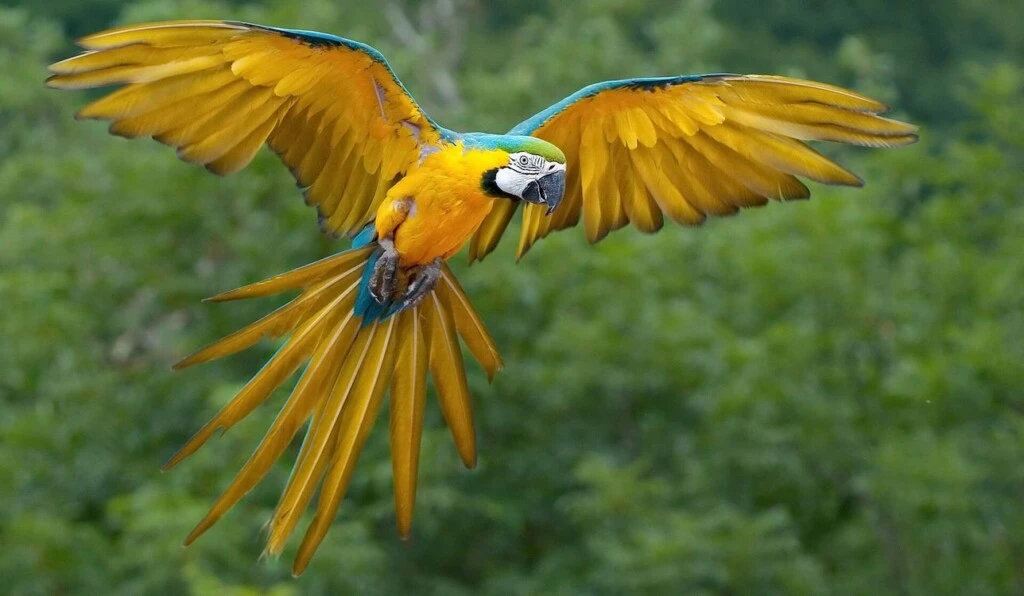
In Rio de Janeiro’s largest urban forest, the noise of the city fades into the background beneath the dense canopy of the Atlantic Forest. Within this restored natural space, conservationists have achieved something extraordinary: the return of the blue-and-yellow macaw, a bird that had vanished from the area around two centuries ago.
The reintroduction, made possible through a captive breeding effort, has sparked excitement throughout the city. For many residents, seeing the macaw in the wild again feels deeply meaningful. The bird has long been a familiar symbol in Rio, appearing on clothing, logos, and souvenirs, yet it had not truly belonged to the surrounding forest for generations.
The return of the macaw is part of a wider effort to restore wildlife once lost from Tijuca National Park, a 10,000-acre protected area. Over the years, animals such as howler monkeys, yellow-footed tortoises, and red-rumped agoutis have also been reintroduced after disappearing because of hunting and habitat destruction during the 19th century.
Although these projects have all drawn interest, few animals have captured the public imagination quite like the macaw. So far, four of the striking birds have been released into the trees, delighting both visitors and locals.
Viviane Lasmar, director of Tijuca National Park, described the reappearance of the birds as especially moving. She said visitors constantly ask how they can spot them, and for her, both as park director and as someone from Rio, their return feels like a dream fulfilled.
The organization leading the release is Refauna. Earlier this year, the birds were allowed out into the forest for a 15-day period before being brought back into the aviary. Another release may happen in September, when food sources are more abundant and conditions are more favorable for a permanent return.
This gradual approach is necessary for two main reasons. First, the birds were rescued from captivity, meaning they have not yet developed the strong flight abilities needed to travel long distances in search of food. Second, they need time to adjust to the sounds, smells, sights, and food sources of their natural environment.
Beyond their beauty and symbolic importance, the macaws may also help restore the surrounding ecosystem. The Atlantic Forest has been reduced by about 90 percent since colonial times, even though in its healthiest state it supports extraordinary biodiversity.
Because macaws have strong beaks capable of breaking open hard fruits and nuts, they play an important role in seed dispersal. By helping spread the seeds of native trees, they may contribute to the regeneration of the forest itself.
Marcelo Rheingantz, executive director of Refauna, said the macaw has become a symbol of the broader mission to bring wildlife back to Tijuca. He added that his hope is that one day these birds will travel far beyond the park and become visible across the city once again.