

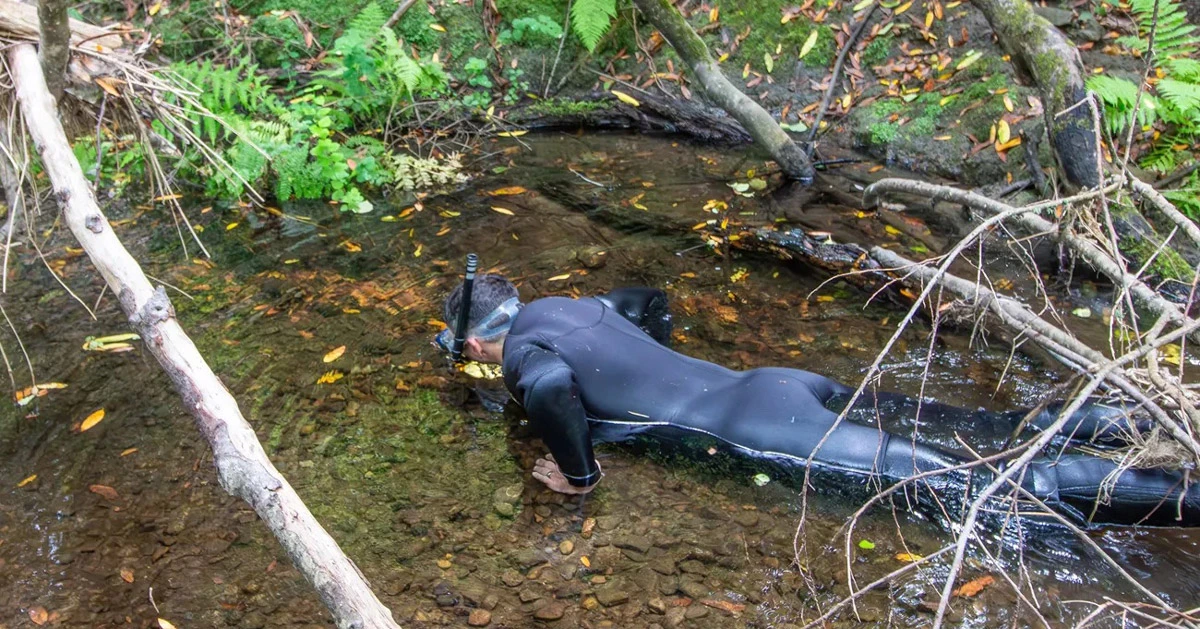
ast September, Michael Reichmuth, a fisheries biologist with the National Park Service, made an extraordinary discovery while snorkeling in Olema Creek at Point Reyes National Seashore. During a survey in the chilly waters, he came across and photographed a cluster of newly hatched California giant salamanders — something scientists had never documented in the wild before.
Reichmuth is no stranger to creek surveys. He has spent more than two decades snorkeling through the waterways of the San Francisco Bay Area’s national parks, usually searching for endangered juvenile coho salmon. Even with all that experience, this sighting stood out as something truly exceptional.
Experts later reviewed the image and agreed that the animals were most likely California giant salamanders, a rare and elusive species known scientifically as Dicamptodon ensatus. According to amphibian specialist Patrick Kleeman of the U.S. Geological Survey, the setting and the animals’ appearance strongly supported that identification. Unlike local newts, these larvae showed features that matched giant salamanders at that early stage of life.
One reason the finding was so remarkable is that almost nothing is known about the species’ earliest development in the wild. The larvae were seen grouped tightly together beneath rocks in a calm stretch of creek, each carrying a pale yolk sac that helps sustain them before they begin feeding independently. Because so few observations of eggs, nests, or hatchlings exist for any giant salamander species, this image offers an unusual glimpse into a life stage scientists rarely, if ever, get to study directly.
Although the California giant salamander is not federally listed as endangered, it is considered a Species of Special Concern in California and is classified as near threatened by the International Union for Conservation of Nature. Researchers still know relatively little about its population trends, movements, habitat preferences, and early survival needs. That makes discoveries like this especially valuable.
The photo does more than capture a rare moment. It also gives researchers new clues about where these salamanders nest and when their larval development begins in natural conditions. Scientists say that kind of real-world information is important for improving future research and conservation efforts.
Despite their name, California giant salamanders can be surprisingly hard to find. They may grow up to a foot long and are the largest terrestrial salamanders in North America, yet they are secretive animals that often avoid the traps scientists use to study amphibians. That is why Reichmuth’s unexpected encounter has become such an important contribution to understanding the species.
The National Park Service hopes this discovery also inspires visitors to stay observant in nature. While people are not allowed to snorkel in these protected creeks, they may still spot California giant salamanders during visits and can contribute by sharing photographs and observations with ongoing wildlife inventories.